
A growing number of us are talking extensively about academic reform. Some folks talk about specific problems that need addressing, some have specific solutions, and some have general philosophies about how to confront these problems and hopefully fix them. I like to write about academic reform, and I’ve noticed that across my writings, the same themes keep coming up. Sometimes, I feel like I must sound like a broken record. I’ve started to think of these recurring themes as my key principles. So I sat down and started to write them out. Maybe they’ll change over time, but most likely I’ll add to them or elaborate them (especially as I work through possible tensions I’ve not yet considered or have so far resisted addressing) because I think of them as pretty core to how I want to do things generally. So this post shares my personal principles for academic reform, which are not unique to me—others have also shared as well. Indeed, several came up at the HxSS conference last week either from speakers or in the Q&A. They certainly aren’t universal principles—some might criticize them as idealistic/naive. But at least for now, I think they are crucially important.
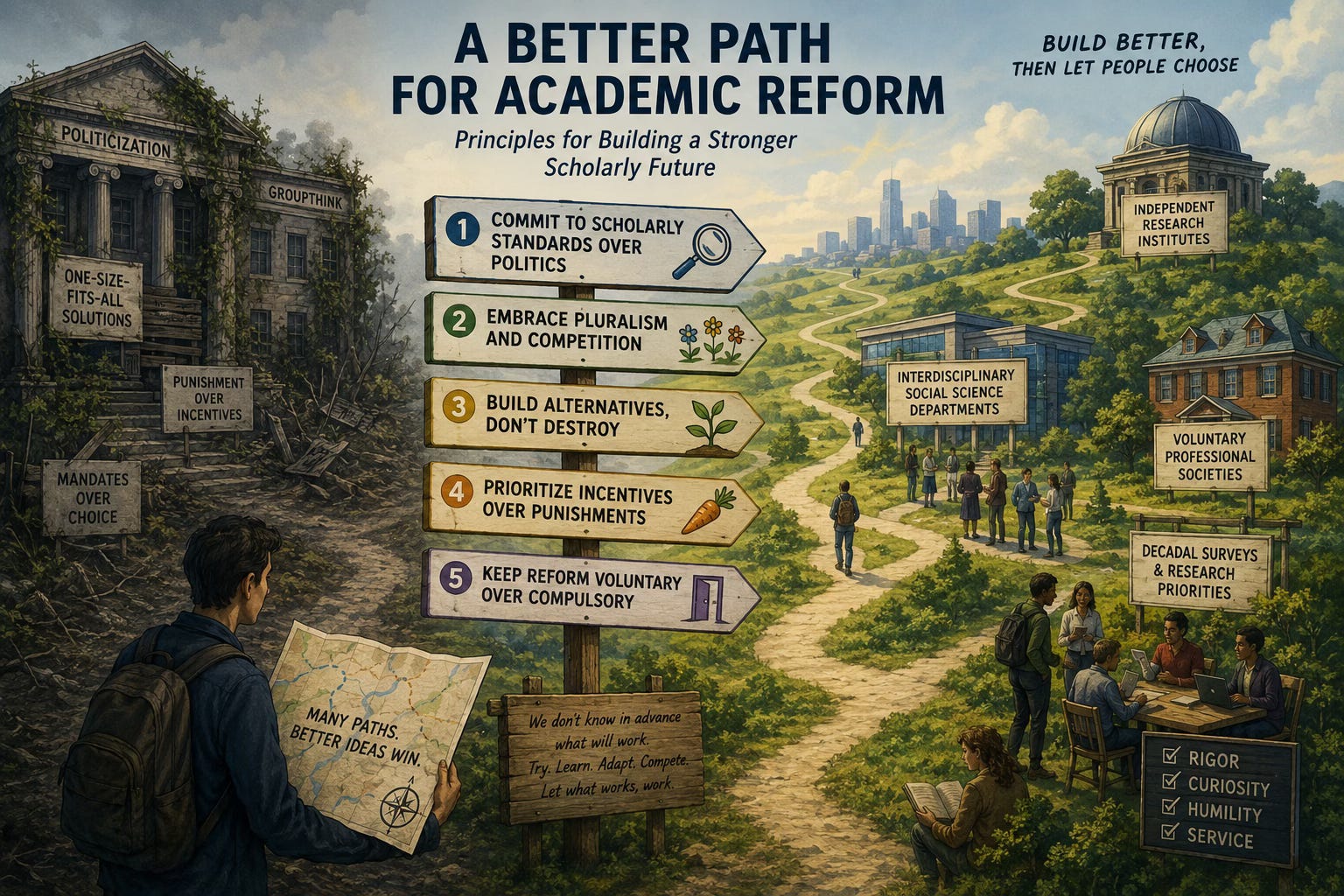
Key Principles for Academic Reform
A commitment to scholarly standards rather than political considerations. Don’t replace one politicization with another. The solution to woke isn’t anti-woke; it’s sticking to rigor at the individual and field levels. The one thing we should all be able to agree on is our job is to figure out the truth—as challenging as that is. That should be the guiding principle for all that we do.
Embrace pluralism and competition in reform efforts. Let market wisdom prevail.* Use a laboratory of democracy mindset or a let a thousand flowers bloom approach. That is, try out multiple proposals and see what works. Avoid a one-size-fits-all approach. The honest answer is we don’t know what will work ahead of time, so let’s try a bunch of things out and see how it goes, then reassess and regroup. Additionally, different folks are concerned with different problems; they’ll come up with proposed solutions for their problems. If we allow for this decentralized approach, and avoid a narcissism of small differences mindset, we might actually get somewhere. *Just clarify, by market wisdom, I don’t mean privatization; I mean look at supply and demand—like what classes, majors, and universities do students enroll in or what do funders want to reward with funding. GPT suggested evolutionary selection might be a better metaphor.
Build up alternatives rather than destroy the dead wood. Create alternative structures that can sit alongside existing structures, then let the market decide which to reward. This principle is an extension of #2 and rests on the commitment to competition. But the idea is that we don’t need to cull the faculty or curriculum; we just need to offer competent, viable alternatives to what’s available and then let students, faculty, policymakers, funders, and others see which ones they want to flock to and support. (Yes, there are limits to this principle—market logics sometimes overlook crucial parts. But I think this will be a bigger problem after an initial round of reforms have gone through and we’re in a new status quo. But for a reform period, I think this is a second-order problem. Also, I want to acknowledge that building alternatives is more time consuming and resource intensive than working with what you have, but sometimes working with what you have is just not going to be productive.)
Always prioritize incentives over punishments (carrots, not sticks). Incentivizing good behavior is a powerful way to get people to behave better. I think a lot of us are much more responsive to carrots over sticks. Plus, few of us want to be in the business of policing others’ behavior (barring extreme circumstances); if nothing else, it’s time-consuming, not productive, and deeply uncomfortable. And it’s hard to do well and consistently and you have to deal with slippery slope issues.
Keep things voluntary rather than compulsive. #5 is really an extension of #3 and #4. Coercive strategies feel gross and will create resistance. Better to open a pathway to people and give them the chance to walk through it. Downstream, if the option has been around for a while, it’s well publicized, and people are consistently choosing not to walk through it, then we start to run into #2: if there’s a market for what they are doing, great; if not, well then market forces will create problems for those who want to stay the course.
GPT’s Contributions
(I saw that Substack is asking authors to be transparent about their use of AI, so I’ve added this section in. Plus, GPT raised some interesting points. This might be better in an appendix, but it’s more relevant here.)
I wrote out three of these as a brain dump and then I asked GPT to read my Substacks and my research journal (where I keep a lot of these notes), and see what it thought my principles were; that yielded an initial list that didn’t quite match what I wanted, so I gave it my three, then it gave me another list, which led to me adding two more to my list. In the process, GPT summarized my approach: “Build institutions that reward good scholarship rather than institutions that try to impose correct politics.” And: “Academic institutions should evolve through selection rather than central planning.”
When I gave GPT my draft post, it criticized the list structure. Okay pot. But it did have an interesting alternative organization: it suggested that the scholarly standards principle is essentially a key goal, from which everything else follows, whereas pluralism + competition and building alternatives were “methods” and incentives and voluntary reforms were more about “implementation.” It’s an interesting reorganization, but I like my list.
Finally, GPT says that one of my underlying principles is “Treat reform itself as an empirical process.” I don’t disagree, but for some reason I want to keep that in a separate pile. Or I just feel like the competition approach speaks to that idea, except that it’s emphasizing the importance of empirically identifying the problem instead of just assuming we know what the problem is. Again, very important, but for some reason I feel like that’s less important to say.
Some Key Proposals
Over the last six or so months, I’ve been making small efforts at concrete suggestions for academic reform, that reflect these ideas: 1) the decadal survey that lays out key research priorities for the field for the subsequent decade, 2) a voluntary professional society that signals and verifies scholars’ commitment to rigor and scientific/scholarly standards, and 3) interdisciplinary social science departments that become islands of refuge for scholars from social science departments that want to balance politics and science (or who prioritize politics over science) and that can become sources of rigorous engagement and scholarly production.
For administrators and those in positions of power, my central message is often: you need to take stock—are most people in the field on board with rigor or not? (Yes, it’s a spectrum, but the question remains.) The next steps will differ depending on how many people are committed to rigor and how captured the field is. In a field with problems, if people want change, your job is much easier. If at least some people want change, you have something to work with. But if a lot of people don’t want to change, that’s where working in parallel and letting competition drive matters is going to be key.
Conclusion
Other lists of academic principles will include things like pursuit of knowledge or truth, open inquiry/viewpoint diversity, academic freedom and autonomy, institutional neutrality, civil discourse/respect, public responsibility or responsiveness, etc. Those are all important things that we do and principles we should live by as academics. But they are key for running a university well. Right now, we’re in a situation where those principles aren’t shared, or they don’t mean the same thing to different people, or they are losing their legitimacy (or at least our legitimate claims to them). The standard principles don’t necessarily tell us how to get out of the quagmire we’ve gotten ourselves into—a quagmire in which these ideas have actually fallen to the wayside or are inconsistently applied/respected. It’s not clear that just doubling down on these principles is enough or will actually achieve the desired result. This question of how to get out of this mess is the conversation we’re having. And I hope reform efforts follow these principles of prioritizing scholarly standards, embracing competition across efforts, creating parallel/alterntative structures, prioritizing carrots over sticks, and allowing for voluntary adoption of reforms.
Perhaps I missed something in an earlier post, but you don’t offer a definition of what you mean by “works” in what works.
Don’t we need a general discussion about goals before we can agree about what “working” looks like?