Post Summary: In this post, I use word-usage trends (1940-2025 and 2020-2025) in the American Journal of Sociology to explore whether and how the top articles in the field are homogenizing around ideologically preferred topic areas. More specifically, I follow up on Musa Al-Gharbi’s (2023) claim that the “great awokening” of scholarship peaked in 2021. Whereas he was looking at academic works generally, I zeroed in on one of the most highly scrutinized fields for its “woke” tendencies: sociology. And I look at a more recent (but also narrower) set of data to see if the peak visible in mainstream society or academia overall holds up in my discipline, or if the party train in sociology is still going strong. Spoiler alert: it’s still going strong.
Preamble/Motivation/Caveats
One indicator for evaluating a discipline is the corpus of articles published in its top peer-reviewed journals. The idea is, well, most scholarship in the field might be bunk, but if the top journal is still rigorous, that’s what really matters.
As I noted previously, there’s a key question that an analysis of the field’s top journal doesn’t help us resolve: if your top journal is safe, but the bulk of the work in your field is not (say, more than the standard 90% of everything is shit), can you really say your field is still healthy? I’m still on the fence about this question, but I’d say no. But as I’ve also said before, I think you should look at multiple indicators. Well, one step at a time.
For now, I’m just interested in whether research that is generally considered to be the best in the field is actually immune to some of the changes we’re seeing elsewhere in the field. This question is really important because getting an article in the top journals is supposed to be an instant way to get a job at a top department or to know who is a legit scholar or not. If that metric falls, or gets corrupted, the whole hierarchy falls.
So I have a few projects where I’m looking at trends in articles published in the American Journal of Sociology.
Why AJS? Along with the American Sociological Review, it’s typically considered one of the top two generalist sociology journals. Folks sometimes include the Annual Review of Sociology (on the basis of citation counts), but those are typically invitation-only review articles, which won’t yield the same sort of broad swath. People might also point to Sociological Research and Methods, but I always thought of that as a more methods-heavy journal. I want to look at a generalist journal. The next tier down for generalist journals is, I’d say, Social Forces and Social Problems.
Why am I only looking at one journal (AJS and not ASR)? Some of this is a side project where I was just curious to do a quick and dirty analysis; another portion of it (not presented in this post) is for an actual project, but I’m doing a pilot study. I don’t have time to do more without an RA or figuring out how to get LLMs to work (which others have). And I’m going with AJS instead of ASR because AJS is not associated with ASA; ASR is the ASA’s flagship journal. I’m worried that ASR would be correlated (and causally so) with ASA’s activist bent in recent years, so if I have to choose one, I figure AJS is going to be more of an out-of-sample indicator of field-level trends for elite publications.
Now, I’m going to do a bit of a bait and switch: because I’m doing a very limited analysis in this post, I can’t actually evaluate quality. Yeah, that’s a huge limitation. If I’m interested in whether the field’s top journals are still rigorous, shouldn’t I, you know, measure rigor? At some point, I’d like to do that (e.g., code for things like does the article include a research question, is it framed/motivated well, how good is the methods section, do the findings actually support the conclusions, etc.) But, again, that will require time, RAs, or an LLM. For a side project like this, I can only handle quick and dirty.
But there are actually two ways to look at the quality of the top journals’ articles. Conventional measures of rigor is one (very important) way, but ideological capture is another. Basically, your journal might publish good work, but is it leaving other good work on the table that just doesn’t fit the ideological mold? Or, if it’s not the reviewers and editors, are the scholars conducting work that is good enough to be published in the top journal specializing only in certain areas? And if the latter, are they doing so by choice or because they think it’s what will get published? We can’t measure any of those directly, so we won’t know what the mechanism is, but we can look at the trends in what is published.
As it happens, I’m very interested in field-level trends, including the homogenization of sociology. There are a few versions of this homogeneity: the rise of sociology as inequality studies (or sometimes called “grievance studies”) that Turgut Keskinturk has written about here, the omission of certain key traditional fields or topics (religion, military) unless studied from a critical perspective (e.g., “Christian nationalism”), and the various forms of bias in the literature, including the negativity bias that John Iceland has written about here and the lack of a positive sociology that Fabio Rojas has written about here. I’m also interested in the lack of systematicity in the field: some subfields are super bloated whereas others are sparse; but even within bloated subfields, you get patchiness, where some questions aren’t asked, some theories aren’t explored, some populations and places aren’t studied.
A lot of these outcomes have been attributed to (or described as) the rise of what some call “woke sociology.” Although it goes by different definitions, woke sociology generally refers to sociology that has been ideologically captured by a narrow (sometimes internally contradictory) slice of Progressive-Left politics (Christian Smith’s book does a good job of describing some of the specific platforms, but basically “woke” came to be a pretty good short-hand, despite its limitations and history laid out by Musa Al-Gharbi). It’s also what we might call “activist sociology” where the traditional scientific logics have been replaced by activist logics—research is not guided by research questions but by working for specific kinds of social change; exploring the data is secondary to supporting a preferred argument; traditional rules of research methodology have given way to questions like “who’s voice is elevated here” and “does this finding harm the reputation of the [vulnerable] group studied” (no problem if it harms the rep of groups we don’t deem vulnerable). But to be fair to people who actually work for social change, and as several folks have pointed out, this work doesn’t necessarily actually do shit to improve the situations of the people it aspires to help, nor does it often reflect what they want. That’s because woke sociology is really performative. My favorite version of this trend is using the right jargon to signal one’s politics (like scolding actual prisoners because they didn’t use “incarcerated person” in their writing, which the free readers found offensive—an actual story relayed to me; see also the whole Convict Criminology debate).
Because so much of this trend is performative and more about the visible than the substance, a very simplistic trends analysis actually comes in handy.
Adapting Musa Al-Gharbi’s Approach
I recently read Musa Al-Gharbi’s (2023) HeterodoxAcademy article, “The ‘Great Awokening’ of Scholarship May Be Ending.” He “analyzed articles published between 2000 and 2022 that appeared in Google Scholar, Web of Science, EBSCO Essentials, and Scopus” looking for words popular among “symbolic capitalists,” including “virtually all forms of bias and discrimination (racism, sexism, transphobia, Islamophobia, ableism, ageism, fatphobia, and derivatives of the same)” plus some others like “settler colonialism,” “toxic masculinity,” and “racial capitalism.” He found that after an uptick around 2011, things were starting to wind down around 2021 (this terminology stated to become less common).
However, I was wondering two things: 1) His analysis is now several years old: does the trend still hold up? and 2) This analysis was for all academic articles, but what about in my fields specifically? I’m in sociology plus two interdisciplinary fields, and it does not feel like things are slowing down (maybe this year, but hard to say—plus, there’s going to be a lagged effect since scholarship usually takes at least a year to make it to an internet database). If I had to guess, I don’t think Musa’s general point holds for sociology, but that’s a testable claim.
Well, I can’t replicate Musa’s analysis entirely because it’s really impressive and I lack the type of computer skills needed (at some point, I will ask GPT to teach me…). But I can do a quick and dirty analysis by hand.
I went to the AJS website’s advanced search page and did searches for 1940 to 2025. (For most analyses, I restricted my searches to research articles, but for some, I separately looked at book reviews.) I looked for how many articles were published in each year using a given search term or set of search terms (using a very tedious process that involves clicking the “download citation” button, then copying and pasting the citations into excel, and extracting the years). I then made graphs in STATA.
Which terms did I explore? I was a little choosy about which search terms of Musa’s I used. Of his list, I took: racism OR racist, sexist OR sexism, homophobi-, settler AND colonial*, and “racial capitalism” (the others were probably going to be rarer, so I decided they weren’t woth it). I also added in my own: neoliberal, carceral, and “lived experience.” Since “racial capitalism” only showed up in three articles (all from the 2020s), I did a search for capitalism instead (and got 718 articles). All of these terms are effectively synonymous with “bad” and I’ve argued that in my subfields, documenting and condemning these bad things is all the rage, ultimately taking the place of such insignificant things as theorizing why they happen or exploring the whole range of phenomena without regard to our personal sense of what’s good, bad, or neutral.
Now, I want to be very clear about something: I’m not saying aticles using these terms are low-quality, bad, shouldn’t be published, necessarily activisty, etc. (If I was including some terms like “prison industrial complex,” I’d say I’m deeply skeptical of the piece using it.) Instead, I’m interested in the homogenization of the literature along certain lines that have already been flagged. Moreover, it’s not that these are necessarily bad topics to study, but that there is a whole rainbow of topics out there and the field is really zeroing in on a narrow set of topics. (For a nice list of core sociology topics from the ASA itself, check out its suggested curriculum for intro to sociology. By contrast, the field has become distorted such that intro soc textbooks are now expected to spend more time on race, gender, and sexuality than on organizations, family, education, military/war, religion, the economy, etc.)
Before moving on, let me also say, I get it: word mentions are extremely limited indicators. When discussing in my methods book why autocoding is a bad idea (or at least not a replacement for traditional qualitative coding), I explained that mere mention of a word isn’t necessarily a useful indicator. One could be criticizing the word rather than embracing it; one could be quoting someone else who is using the term. But there are also some analyses where it doesn’t really matter how you are using the term, just the fact that you are using the term. My analysis is in between, which is why I spot-checked my results to see how some of these terms were used.
I also want to add another caveat: if I was doing an analysis like this for publication (involving significance tests and such), I would re-download all the numbers to make sure I didn’t make a mistake somewhere (since I was doing it by hand) or I would have two RAs do the same data collection process and check their answers against each other. I didn’t do that here, so there could be some mistakes, but of course I don’t think that’s the case.
Long-Term Trends in AJS Articles
Let’s start with something like the summary statistics in an article. In this section, I’m looking at the long-term trends (word usage since 1940) rather than the specific question about whether things have changed since 2021, which is coming up.
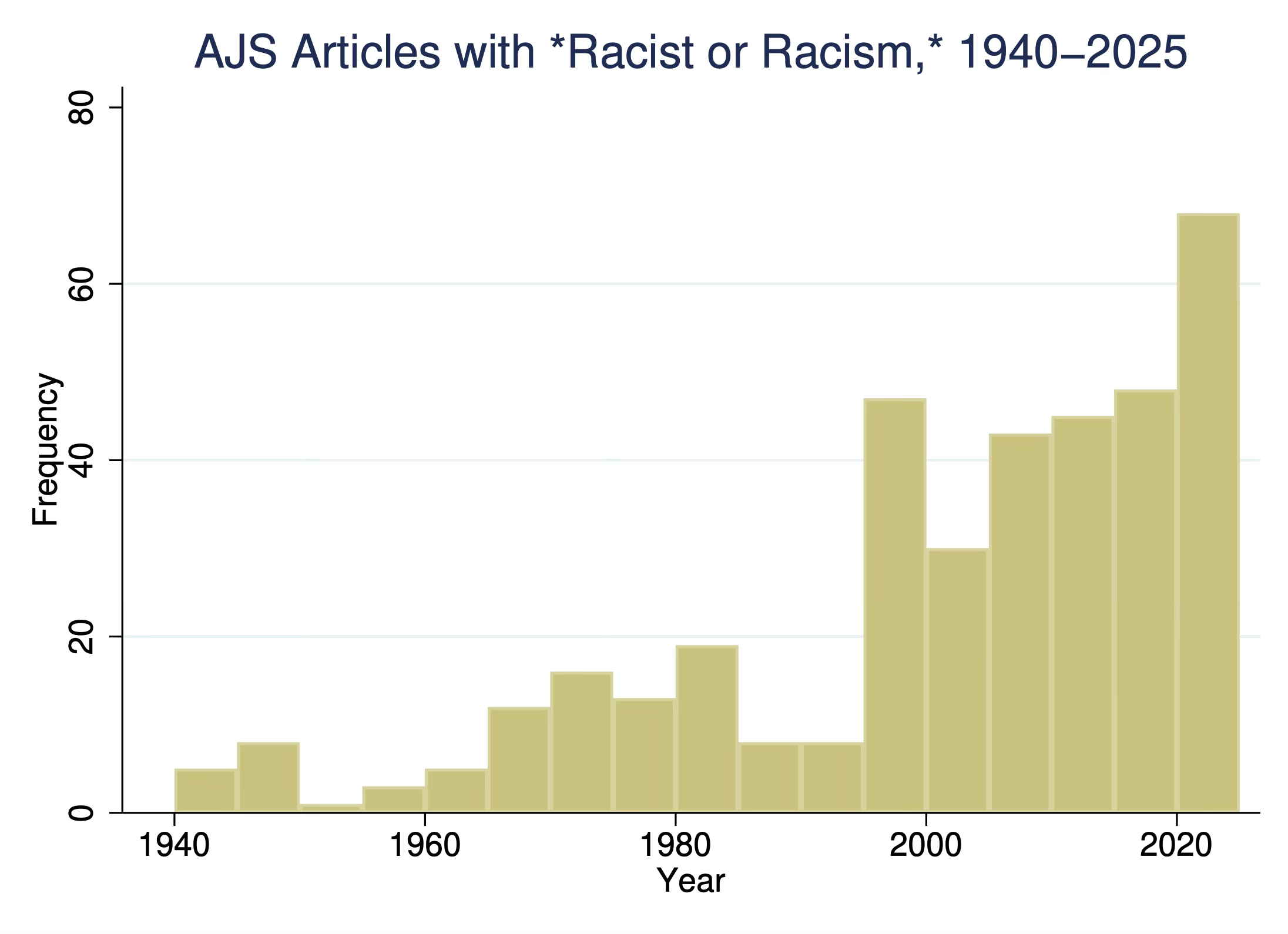
AJS has published articles using the words “racist” or “racism” the whole time (although the fewest in the early 1950s), a mid tick up in the late 1960s into the early 1980s, then a pulling back until another ticking up in the late 1990s onward. The 2020s see an even bigger tick up.
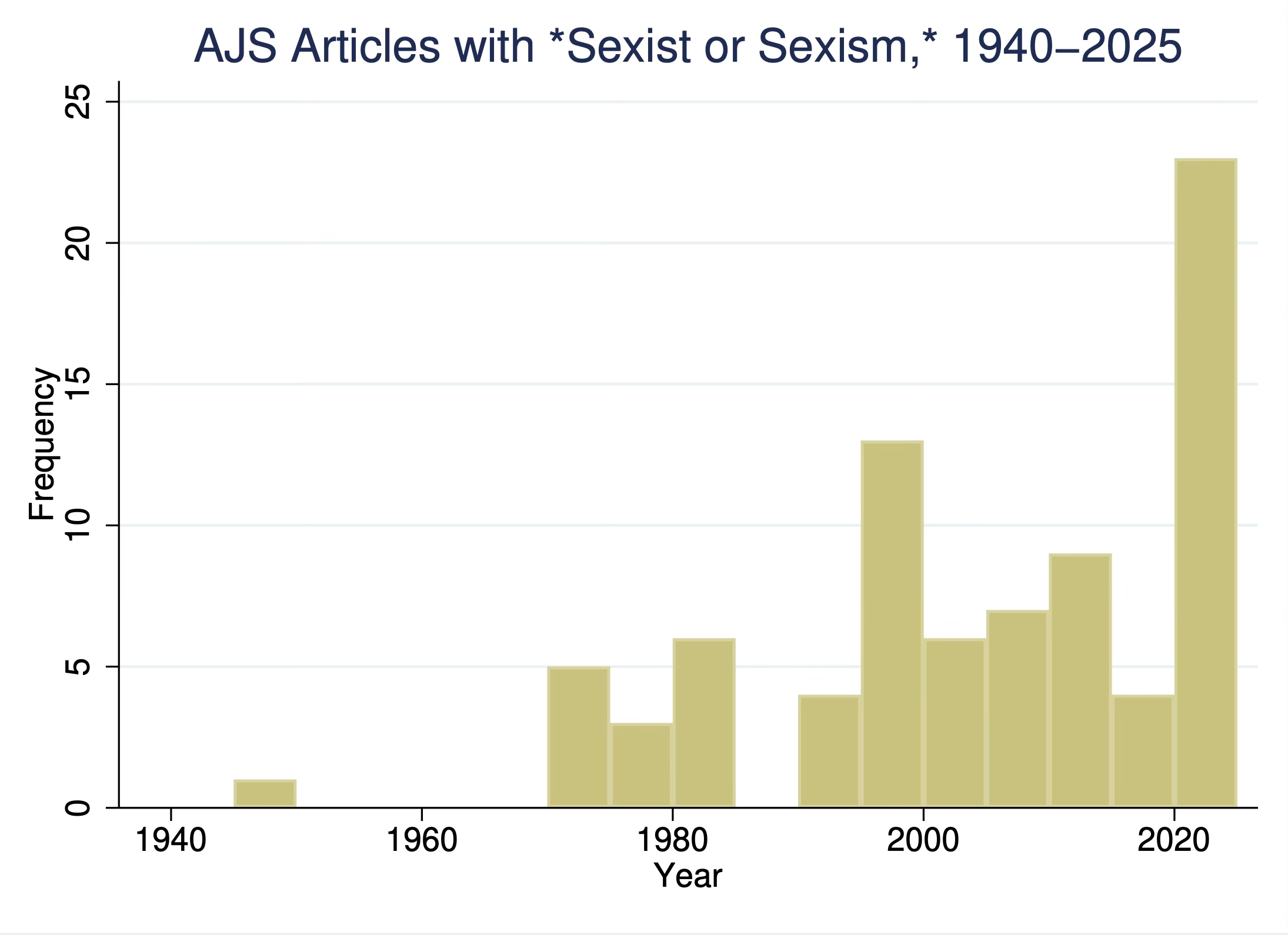
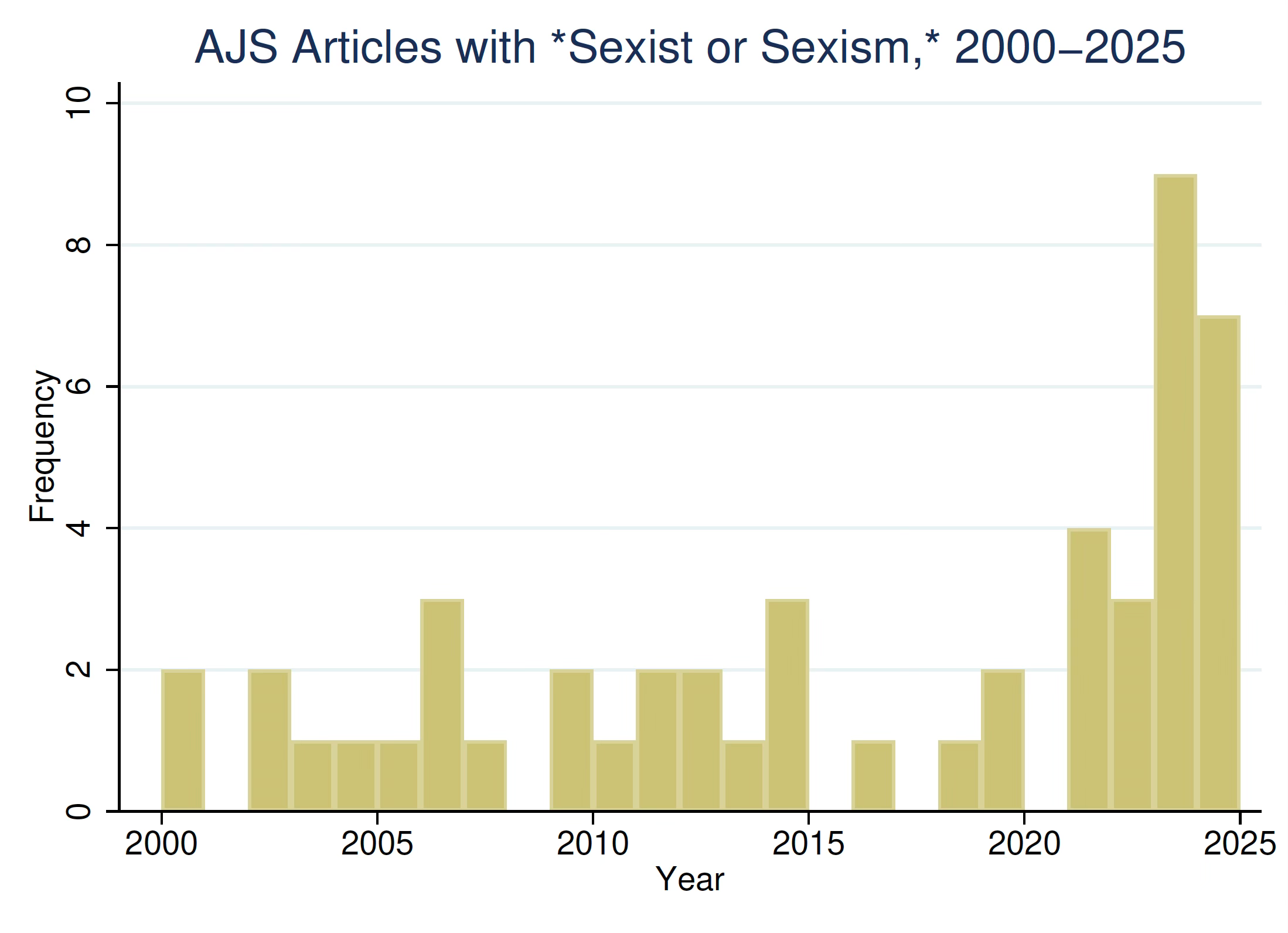
AJS has been more inconsistent in publishing articles using the words “sexist” or “sexism” with almost no such articles before the 1970s, some slight increases in the late 1990s into the 2010s, and then a big uptick in the 2020s.
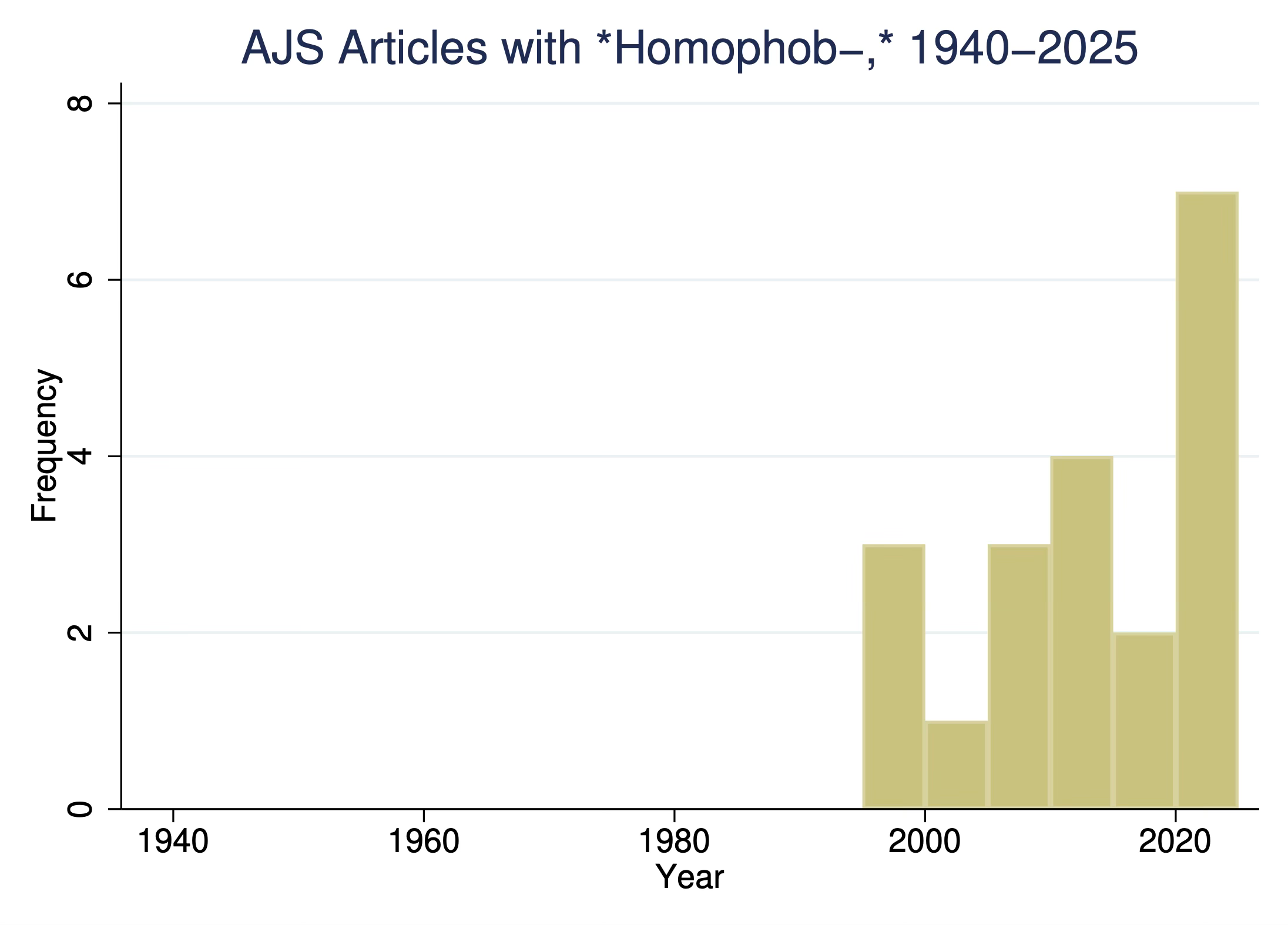
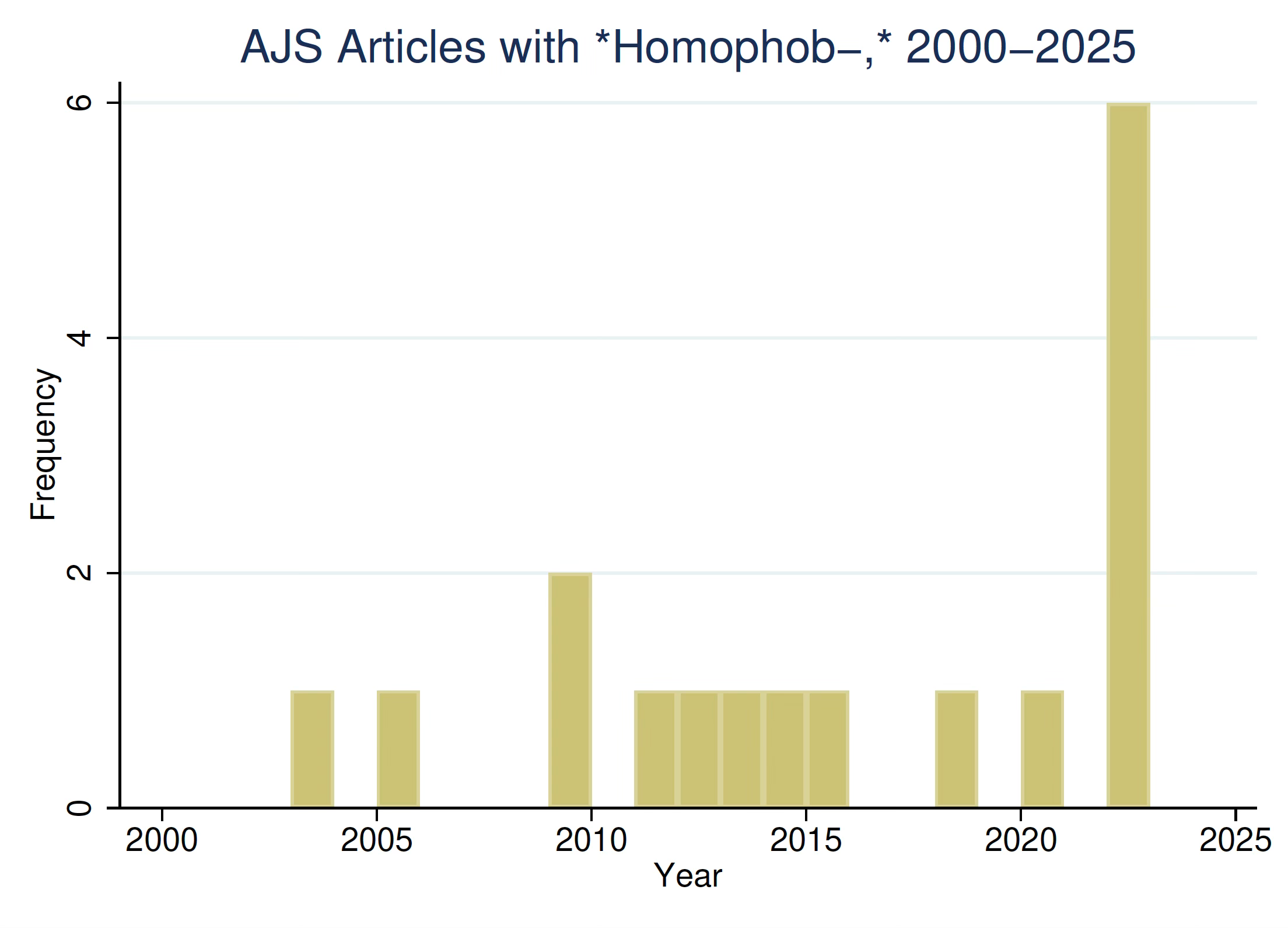
AJS stated publishing articles with “homophobia” and related words in the late 1990s; again, we see a big spike in the early 2020s.
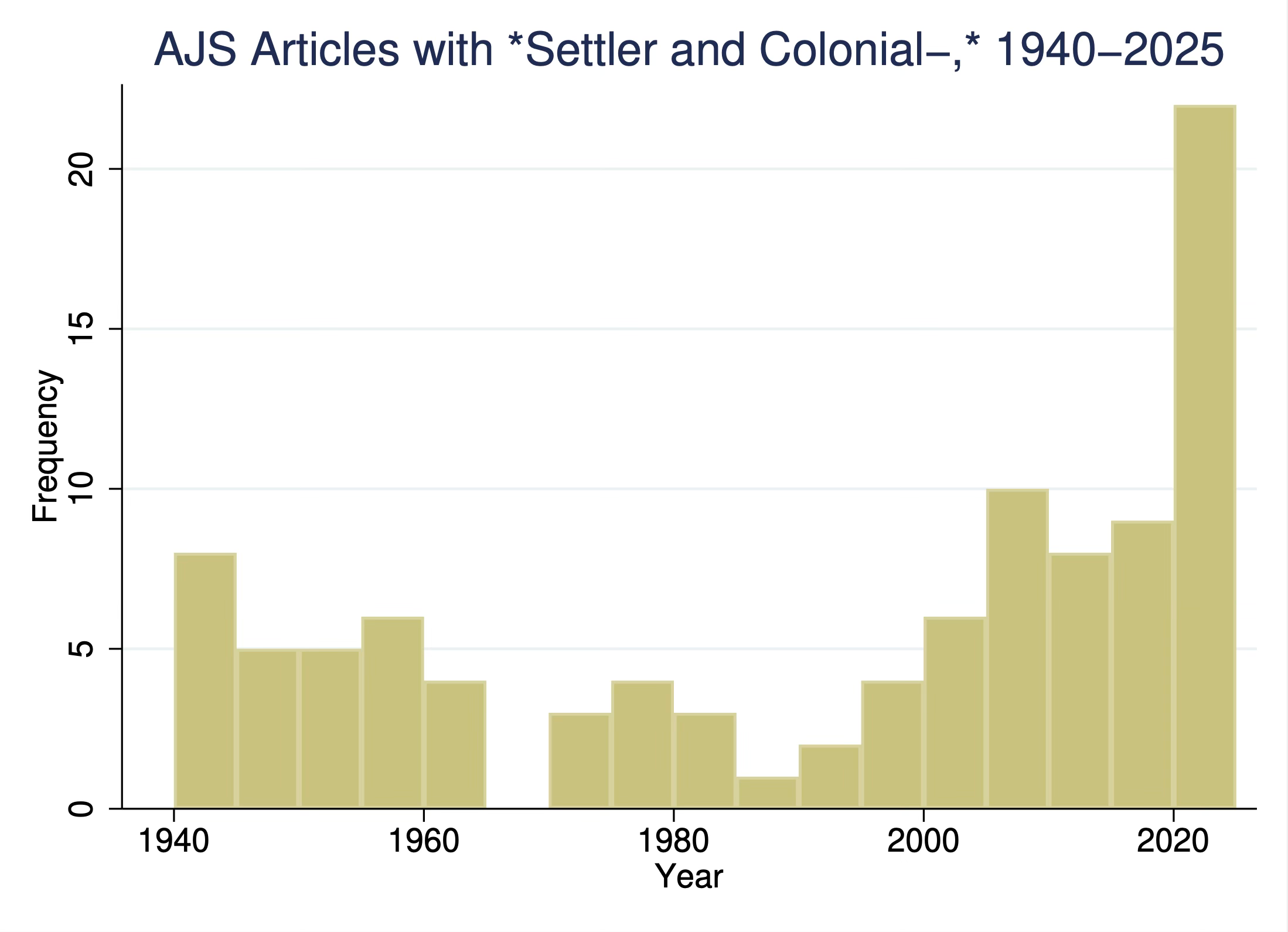
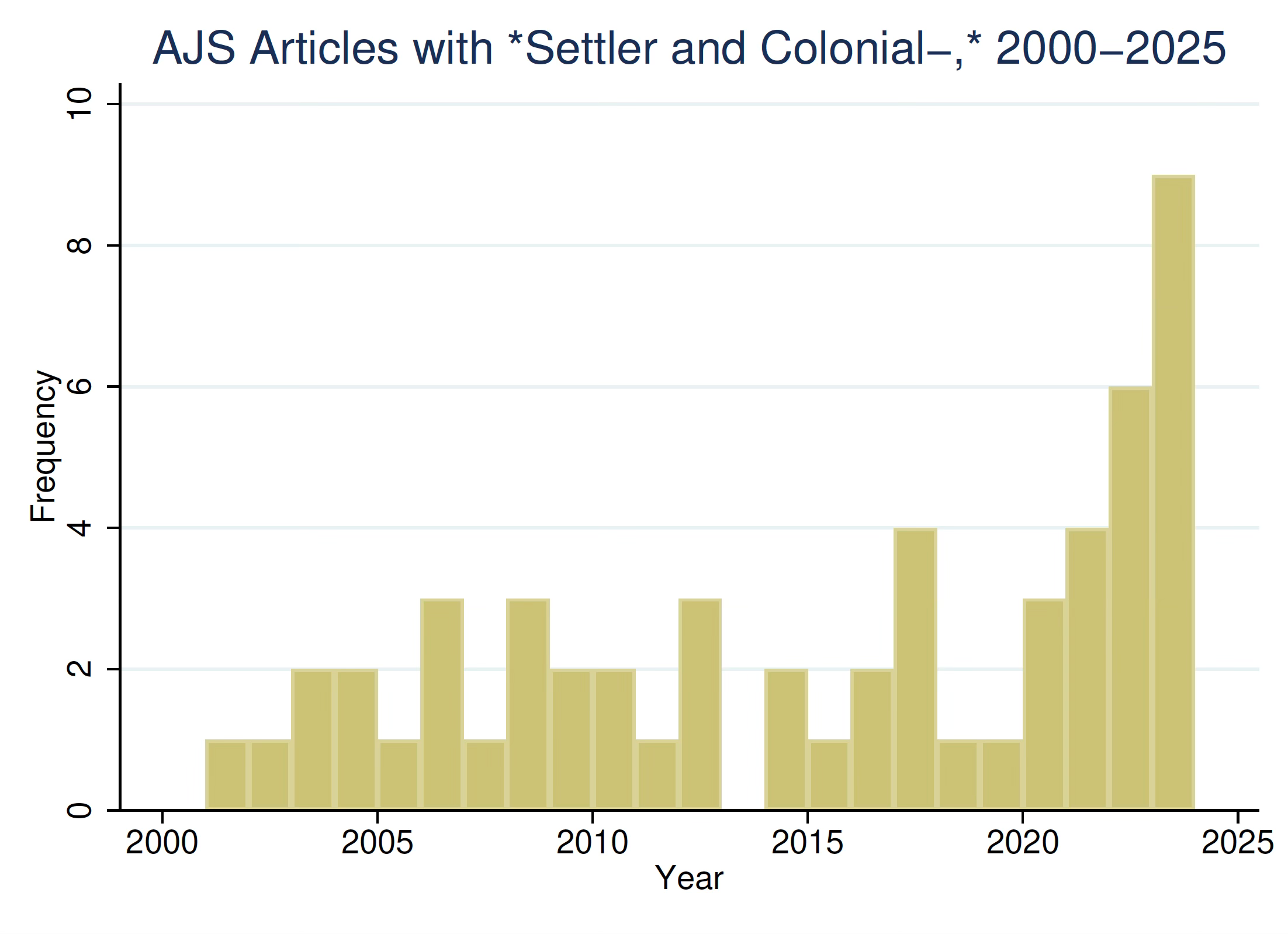
As with racism, AJS has a pretty consistent history of publishing articles with “settler” and “colonial*” (not the same as “settler colonalism” or “settler colonialist”—but folks writing about colonialism and using the term “settler” or “settlers”), but we see an uptick in the late 2000s that stays high until more than doubling in the 2020s.
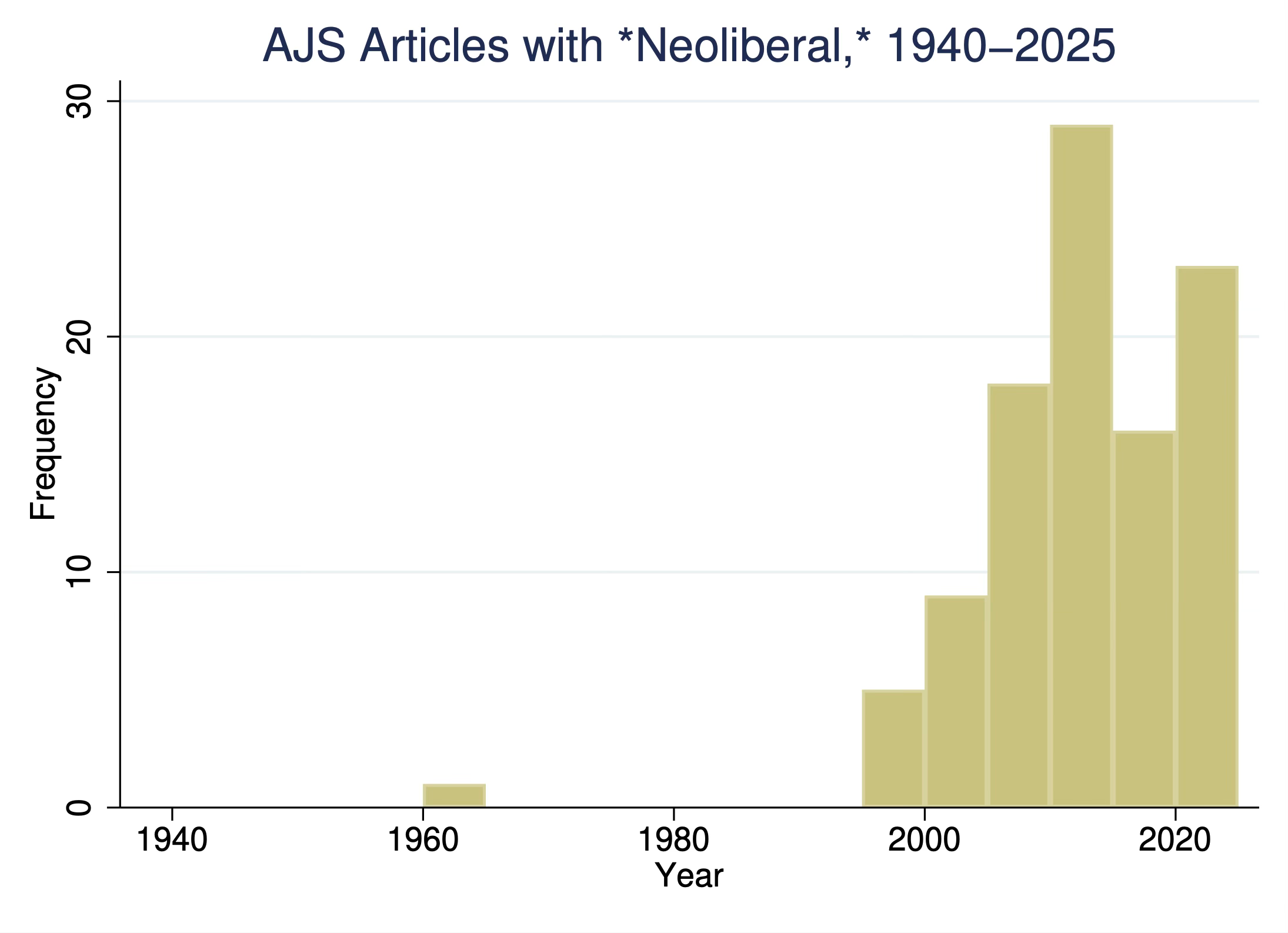
In contrast, neoliberal (and its variations) is only really used in the late 1990s on, peaking in the early 2010s with only a small increase in the 2020s (but not as big as the earlier increase).
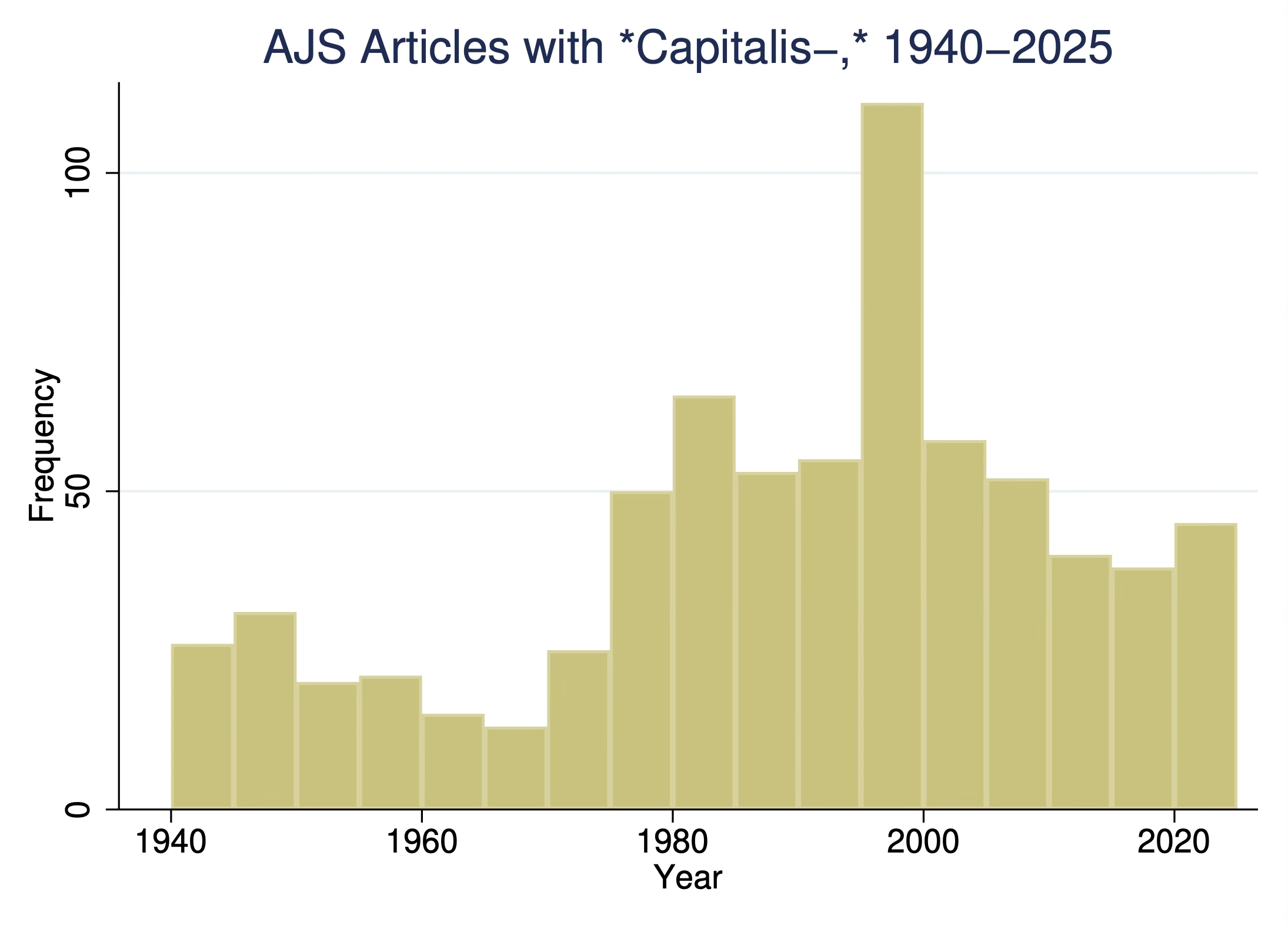
As with some of the earlier words, AJS has consistently published articles mentioning “capitalis*” although we see a decline from the late 1940s to the late 1960s, then an increase that has a local peak in the early 1980s and a second larger peak in the late 1990s, then it gradually declines with a slight uptick in the 2020s, but to a degree lower than the previous decades since 1980 except the 2010s.
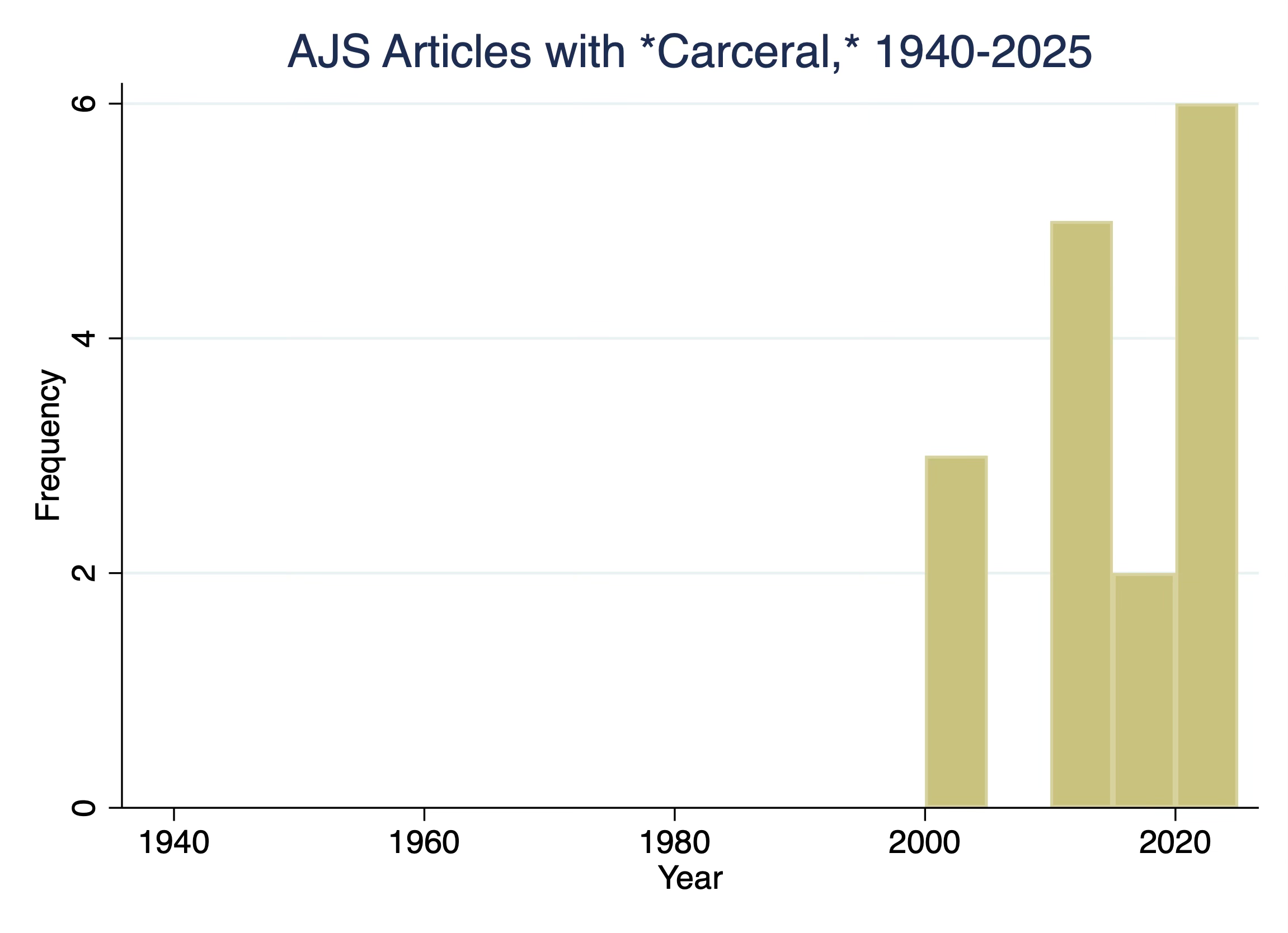
In contrast, AJS only published articles using the word “carceral” in the 2000s, but with a fairly heterogeneous pattern—useage increases in the 2020s but not by that much compared to the earlier peak in the early 2010s.
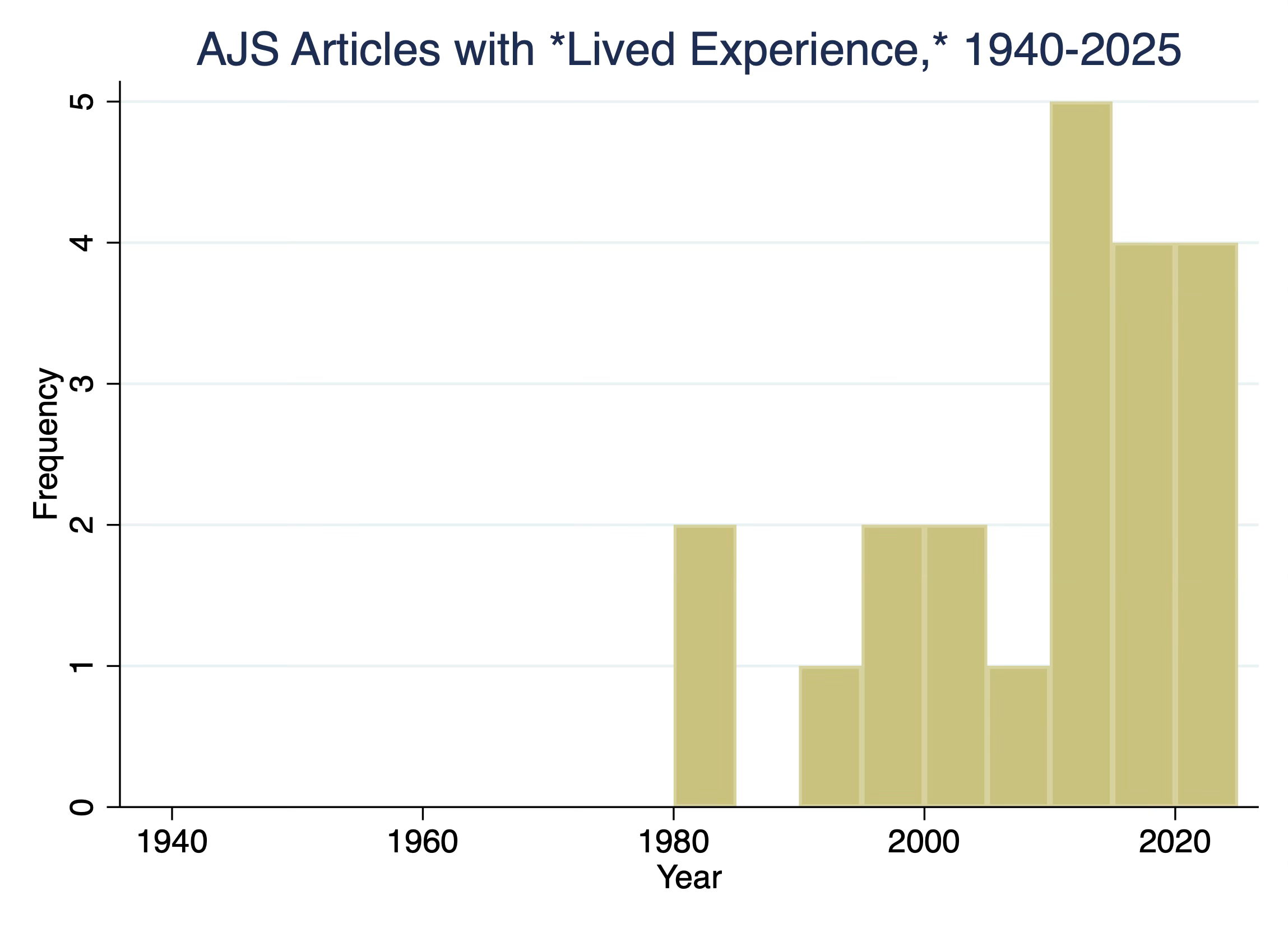
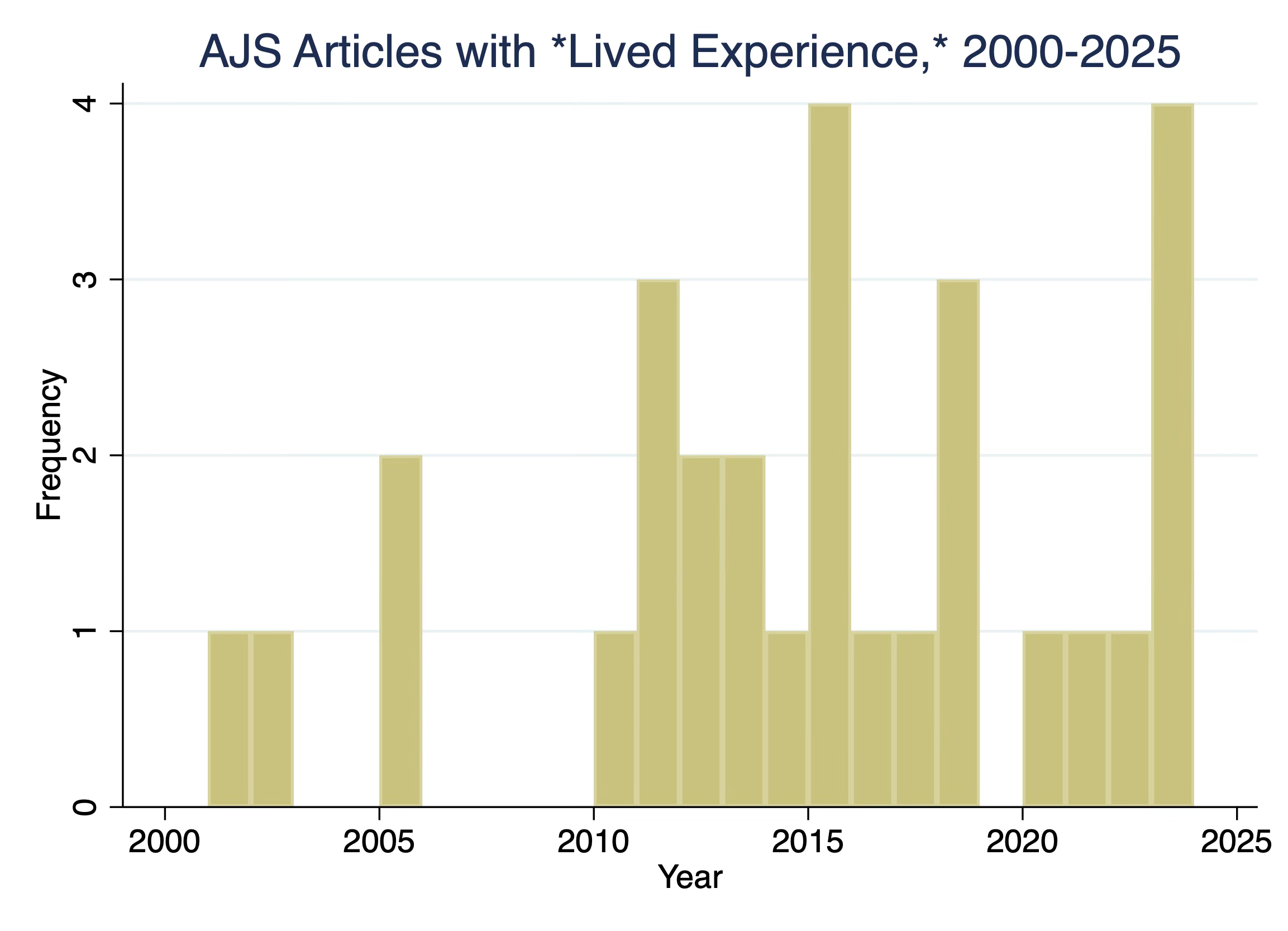
AJS started publishing articles using the term “lived experience” in the 1980s but it became more common in the 2010s (with the early 2010s seeing more such articles than the early 2020s).
So for some words—those related to racism, sexism, homophobia, settler colonialism, neoliberalism, carcerality, and lived experience, we see a general drift up in the last few decades (or longer). In contrast, capitalism saw a general decline. This is generally consistent with the narrowing of sociology into a field of inequality studies focusing on specific forms of inequality (esp race, gender, sexuality) and its growing concern with certain bugaboos (carcerality, neoliberalism, colonialism—but apparently not capitalism).
Now we can ask: do we see a decline since 2021 in the terms where we saw these increases? (That is, ignoring the terms that were on the downturn.)
Findings: The Party Train is Still Going
No, generally we don’t see a decline after 2021. Instead, in fact, the train isn’t just not slowing down, it’s speeding up—for several (but not all) of the key indicators.
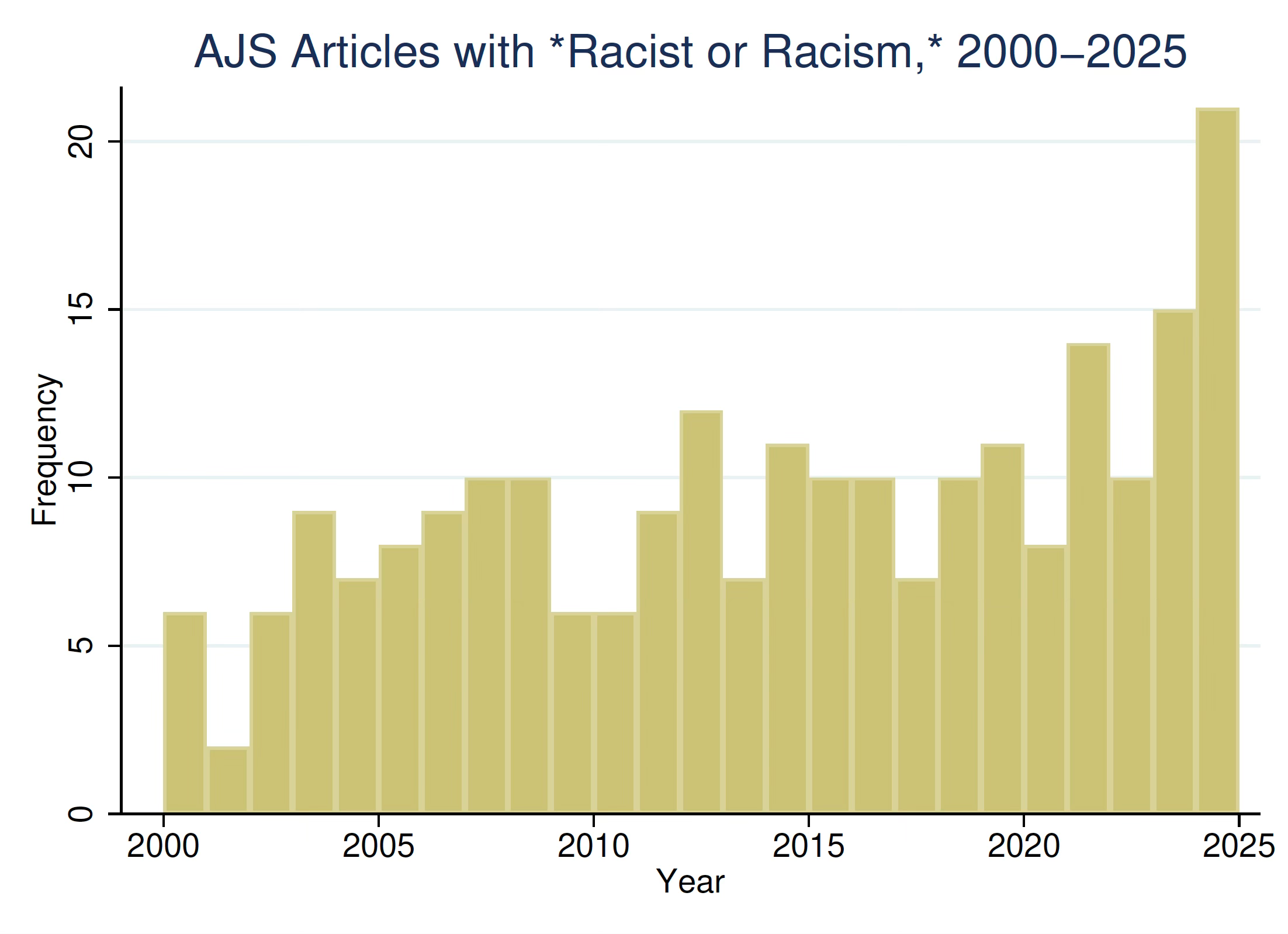
For racism+, sexism+, and carceral, 2024 and 2025 are the years with the highest counts of articles using these sets of terms.
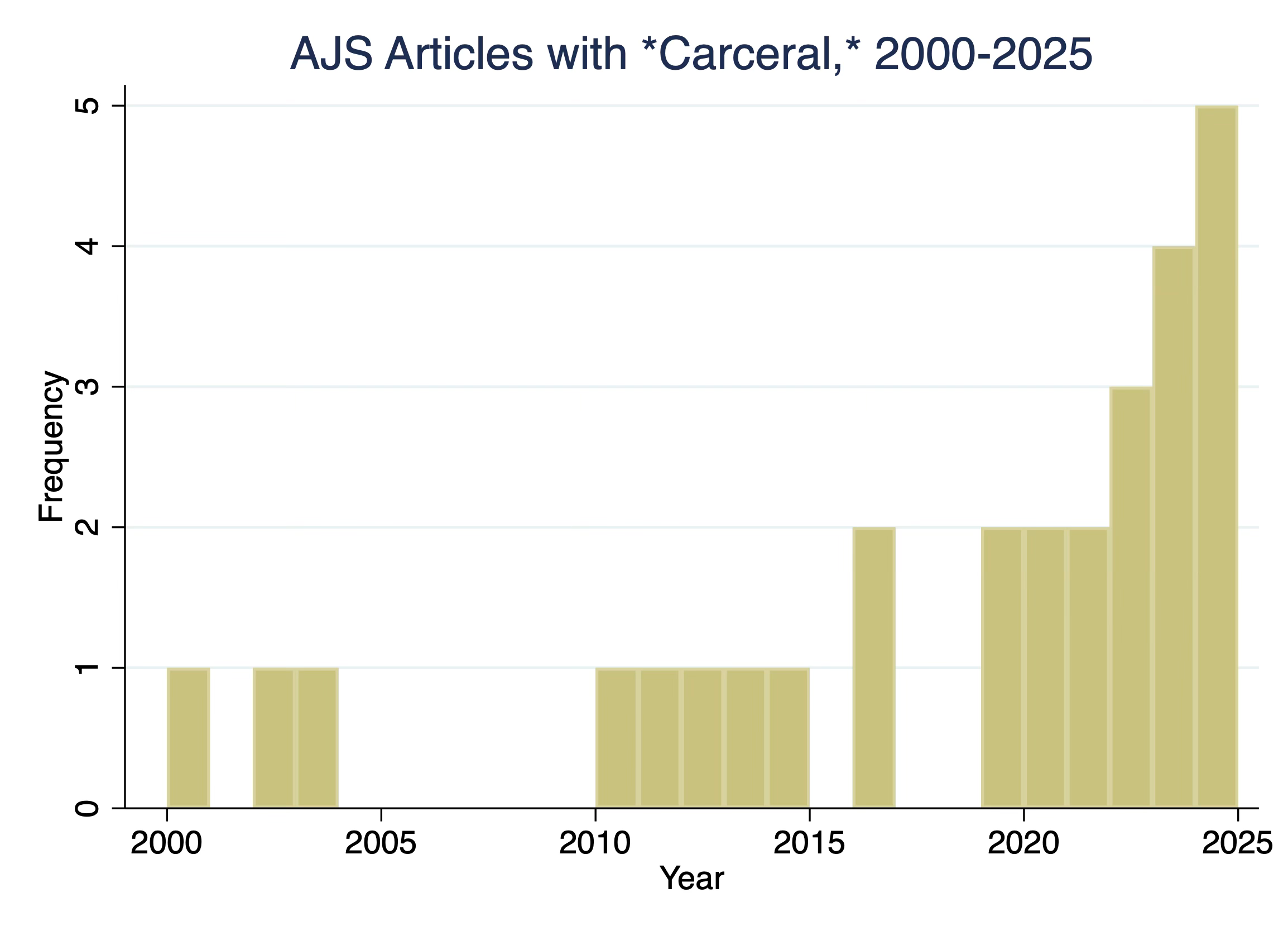
Interestingly, both settler+colonial and “lived experience” peaked in 2024, but had no articles in 2025.
Homophobia+ became pretty patchy in the 2020s, but with a spike in 2023 and then nothing after.
To summarize, we don’t see a pulling back in AJS articles after 2021—instead, peaks continued after that year. We see some mixture in the various indicators with the strongest trends continuing for racism, sexism, and carceral things.
So I don’t think we have evidence that the “Great Awokening” for sociology has ended. Given lag times in publication, it’s possible that things have started to turn around, but we won’t be able to notice it with this method for another year or two. But given the role of incentives and fads/fashions, and the long-term rising popularity of a lot of these topics, I don’t think we’ll see a sudden decline anytime soon without an exogenous shock. And while you may think the Trump administration cuts to funding could be exactly that, keep in mind that a lot of published work isn’t (directly) funded by the federal government (or (directly) funded, period). Instead, I’m thinking something like a concerted effort by editors, grad programs, or ASA officials to try to have a more topically balanced field by incentivizing scholars to be more systematic in their topics so that we don’t simply become the inequality discipline instead of the discipline that studies society generally.
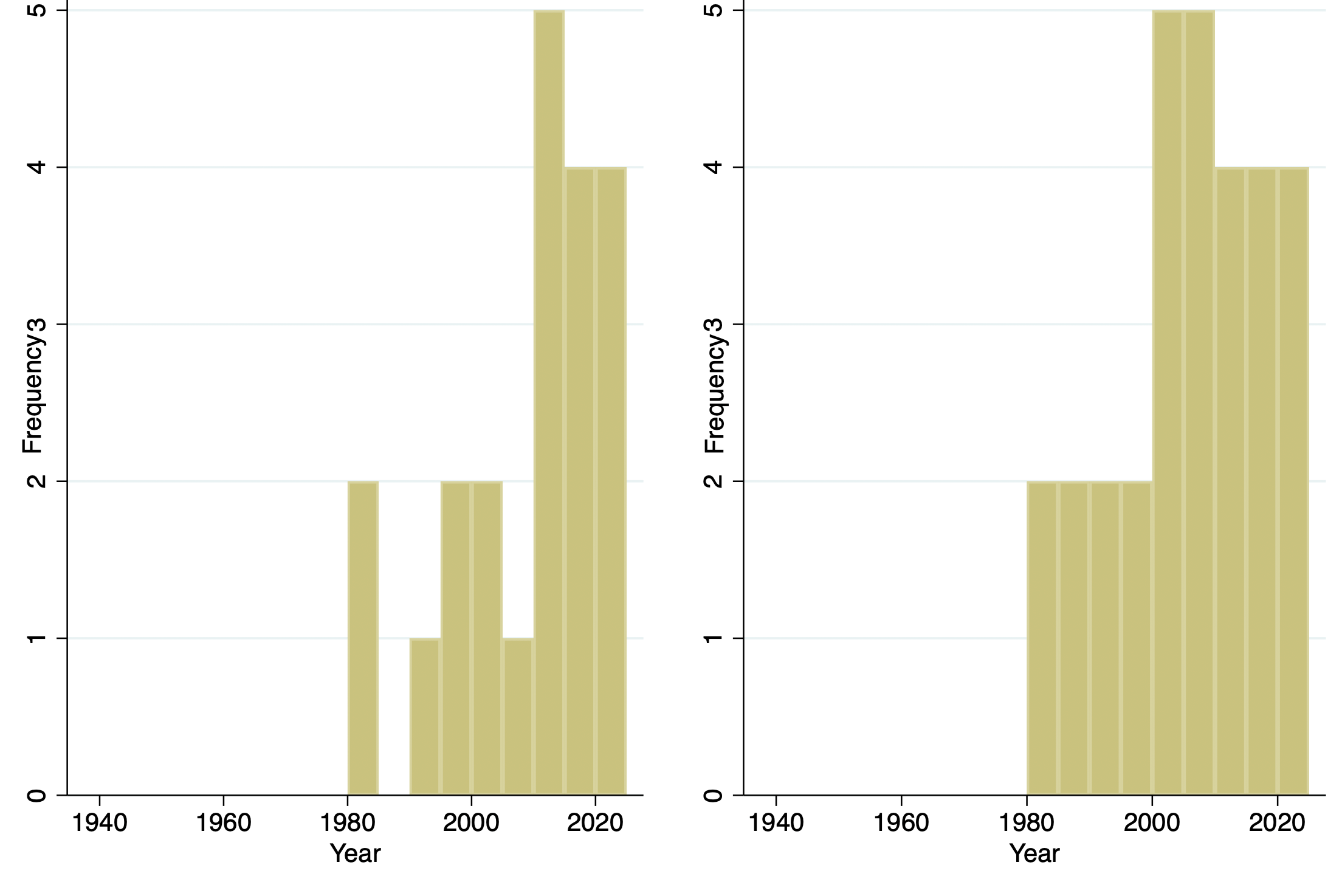
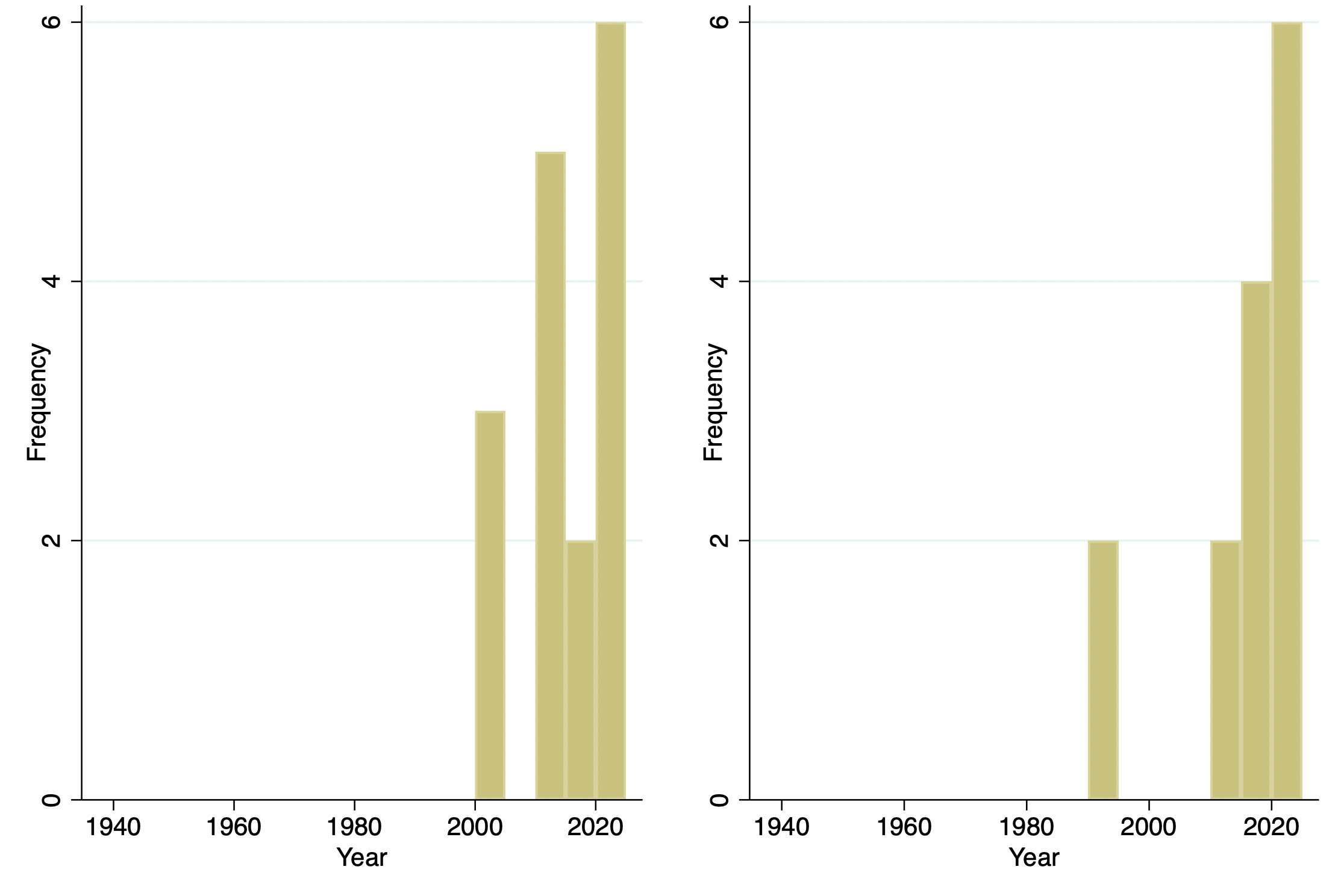
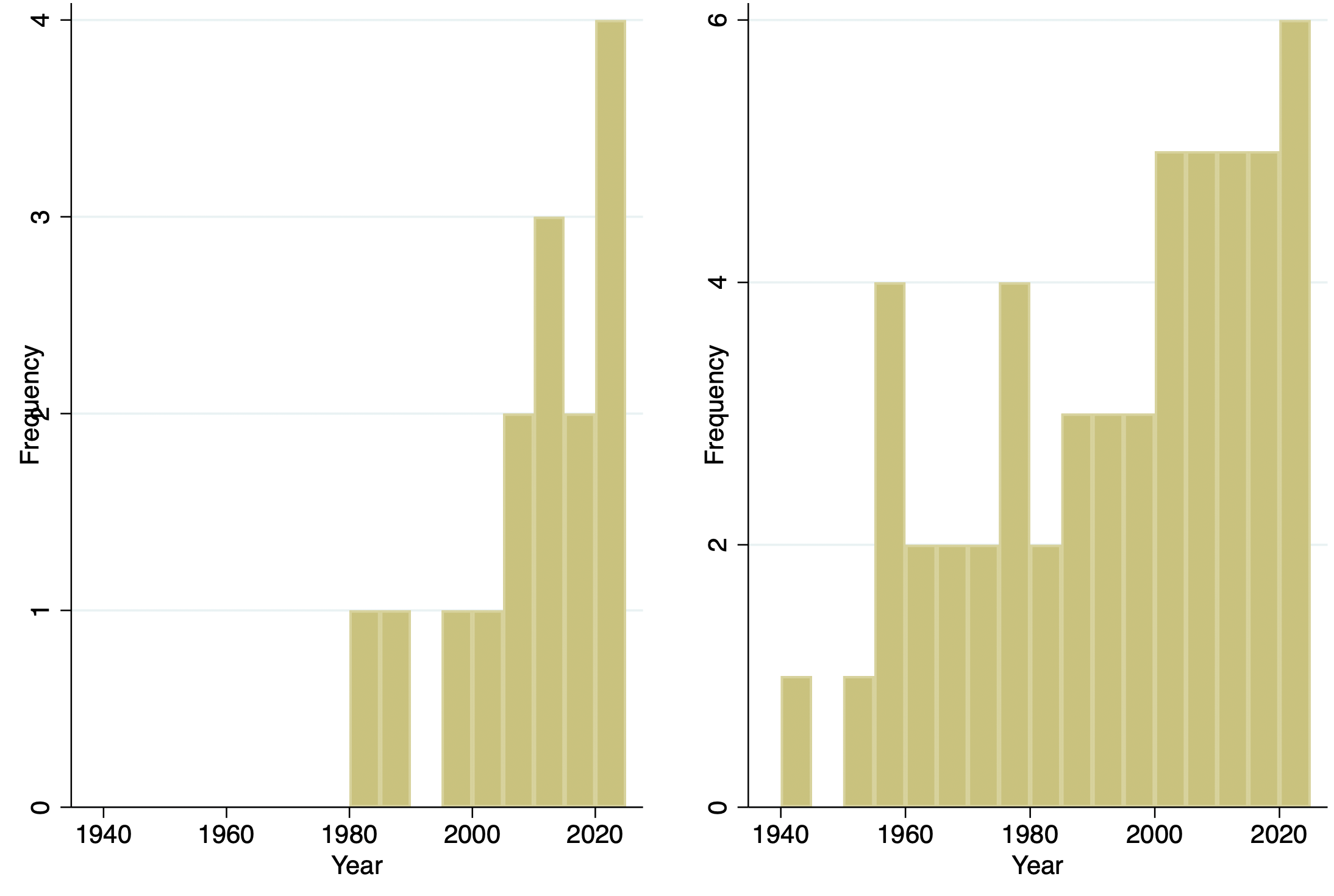
As I’ve mentioned before, the trends are probably more visible in other areas like subfield and interdisciplinary journals. Indeed, in a bonus analysis (below) I looked at three sets of words (lived experience, carceral, and colonialism) in AJS book reviews versus articles. In general, we see the words used slightly earlier and more frequently in book reviews than in peer-reviewed articles, suggesting book reviews are an early indicator of trends.
Stay tuned for additional analyses zeroing in on a specific topic area within AJS articles to see, within a given subfield, what sorts of changes we see.
Appendix: Bonus Analysis—AJS Articles v. Book Reviews (Selected Words)
Note: These graphs are sloppier and I cut off the headings since they overlapped and were unreadable and I was too lazy to fix them. The first is lived experience, the second is carceral, the third is colonialism. In each case, you have the histogram of articles (left) followed by the histogram of book reviews (right). Note that the axes are not always the same across the two graphs (the last combo has different axes).